Doctor, I’m scared of the HSG. What women should know before the test that checks their fallopian tubes
 52 Reads
 3 minutes read

A test many women fear can provide important answers about fertility—and, in some cases, may even help clear a minor blockage.
By Dr (Maj.) Harshita Surange
Trying to get pregnant but not getting answers? You may have been advised an HSG/ tube test—(Hysterosalpingography), an X-ray test that checks whether your fallopian tubes are open. And if your first reaction is, ‘But I’ve heard it hurts,’ then you’re not alone.
That is often the first question a woman asks when she is advised an HSG during a fertility check-up.
The good news is that an HSG does not have to be an ordeal.
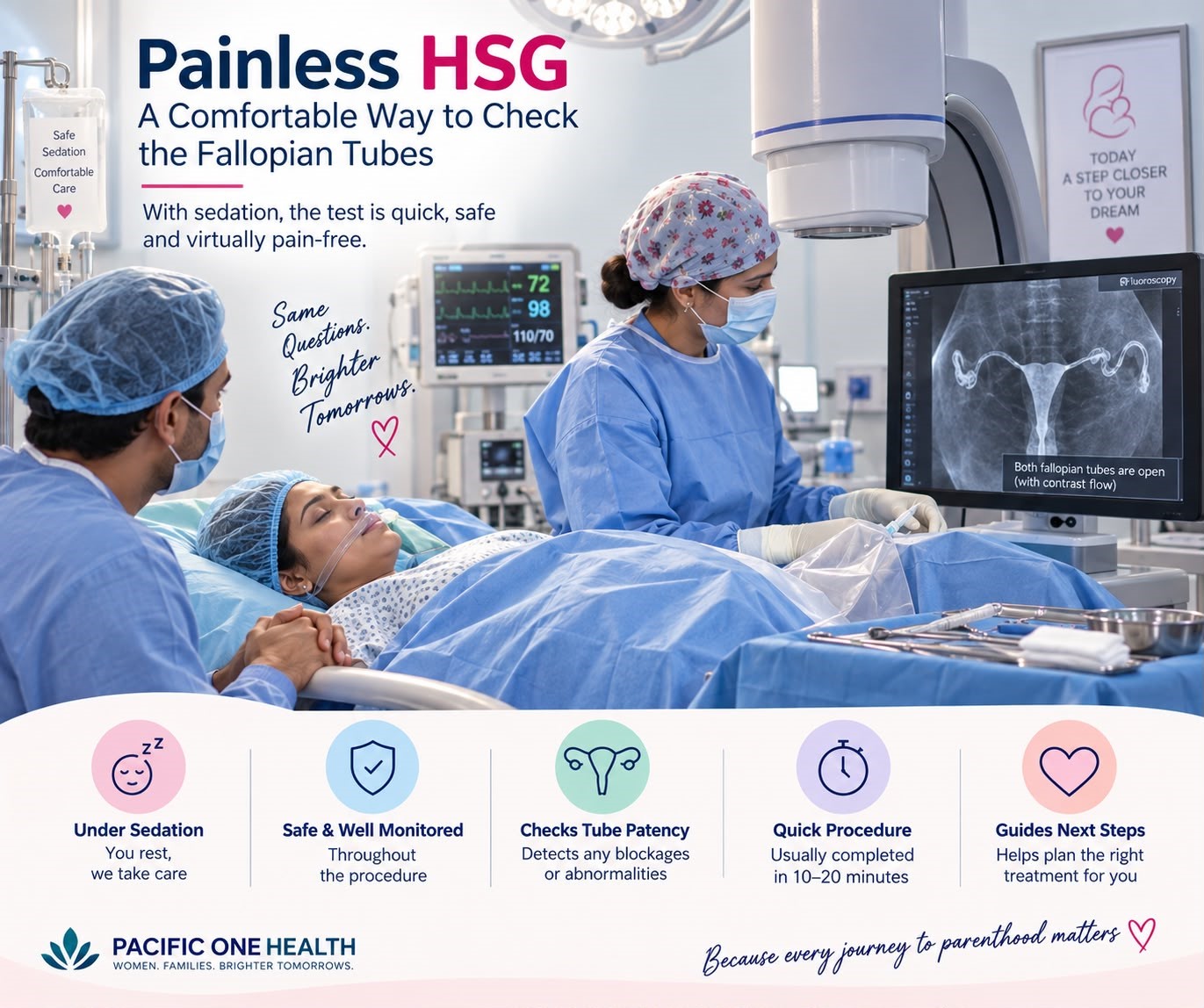
A painless HSG is an X-ray-based test used to see whether the fallopian tubes—the tiny pathways through which the egg travels—are open. At Pacific OneHealth, the procedure is performed with real-time X-ray guidance and monitored sedation to make it more comfortable while getting clear information.
Why do I need this test?
Think of the fallopian tubes as two small pathways where the egg and sperm normally meet.
If a tube is blocked, getting pregnant naturally can become more difficult.
During an HSG, a special liquid is gently introduced into the uterus. We then watch, in real time, how it travels through the tubes.
The test can show:
- Whether the uterus looks normal
- Whether both tubes are open
- Where a blockage may be along with health of tube
- Whether there are changes inside the uterus, such as certain growths or unusual shapes
But what if the report says my tube is blocked?
This is where things can get interesting.
Sometimes a tube may look blocked even when it isn’t permanently blocked. A temporary tightening of the tube, mucus or tiny debris can sometimes stop the liquid from passing.
Real-time imaging helps us understand what is actually happening rather than simply looking at one still picture.
Can the test actually help open a tube?
Sometimes.
As the liquid passes through the tubes, it can have a gentle “flushing” effect. In some women, this may clear a small mucus plug or very fine obstruction.
But this does not mean every blocked tube can be opened. Thick scarring or major damage needs further assessment and appropriate treatment.
Will I get pregnant after an HSG?
Some women do conceive in the months following an HSG, particularly after a water-based contrast test. Research suggests there may be a modest temporary fertility benefit in some women.
But an HSG is not a pregnancy treatment or a guarantee of conception.
Pregnancy depends on many things, including ovulation, egg and sperm health, the uterus and the condition of the tubes.
What happens afterwards?
The procedure is usually brief, and you can generally go home the same day. Some women may experience mild cramping or light spotting afterwards.
So, if you have been putting off an HSG because you are frightened of the pain, talk to your doctor about how the procedure can be made more comfortable.
At Pacific OneHealth, the aim is simple: get the answers you need without unnecessary distress.
Because sometimes, understanding what is happening inside your body is the first step towards knowing what to do next.
Know your tubes. Understand your fertility. Choose the right care.
(The author is the Principal Consultant, Radiology at Pacific OneHealth Hospital, Lajpat Nagar, New Delhi. She is a specialist in painless HSG/ tube test.)