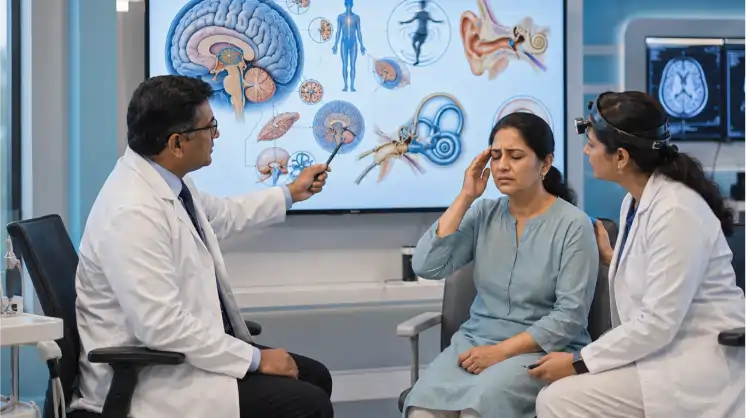
Why I have spent four decades trying to understand vertigo
 126 Reads
 3 minutes read

For most people, vertigo is a frightening experience—the room seems to spin, the ground feels unstable, or the body suddenly loses its sense of direction. For me, it has been the focus of more than four decades of medical practice.
When I began my journey in Neurotology, vertigo and balance disorders were poorly understood. Patients were often told that their symptoms were caused by a problem in the cervical spine, indigestion or, occasionally, an ear disorder. A cervical X-ray would frequently be prescribed, and minor age-related changes could become the explanation for persistent dizziness. Cervical collars, antacids and digestive medicines were common responses. When these failed, many patients simply accepted that they would have to live with the problem.
But vertigo, dizziness and unsteadiness are symptoms, not diagnoses. The underlying cause can lie in the inner ear, brain, eyes, nerves, muscles or other systems involved in maintaining balance. Sometimes psychological and emotional factors can also influence how symptoms are experienced.
Over the years, I came to understand just how intricate this balance system is. The brain continuously integrates information from the eyes, inner ears and body to help us remain oriented and stable. When this network is disturbed, the result may be spinning, unsteadiness, light-headedness, difficulty walking, nausea or fear of falling.
The greatest challenge is that the symptom itself does not tell us its cause.
That is why a detailed history, careful clinical examination and appropriate investigations are essential. Unfortunately, specialised centres equipped to undertake such comprehensive evaluation remain limited in India. As a result, some patients move from one doctor to another while receiving medicines that may suppress symptoms temporarily without identifying the underlying problem.
I often compare this to switching off a fire alarm while the fire continues to burn.
My approach has therefore remained simple: do not treat the symptom alone; understand the person experiencing it.
A patient may describe dizziness differently from another patient, even when their underlying conditions are completely different. Listening carefully—with patience and empathy—can provide the first important clue.
Over four decades, I have been fortunate to contribute to the development of Neurotology and specialised vertigo care in India. Today, I continue this journey in Delhi as Principal Director of the Institute of Neurotology & Centre of Excellence for Vertigo & Balance Disorders at Pacific OneHealth.
The field has evolved enormously, but one principle has not changed: patients deserve to know why they are experiencing their symptoms.
After four decades, I remain convinced that the best vertigo care begins not with a prescription, but with a question:
What is really causing this patient’s loss of balance?
(The author is Dr Anirban Biswas, Principal Director – Institute of Neurotology & Centre of Excellence for Vertigo & Balance Disorders, Pacific OneHealth, New Delhi.)