Vertigo is not always spinning: Why balance disorders need a whole-person approach
 31 Reads
 3 minutes read

By Dr Anirban Biswas
When people hear the word vertigo, they usually imagine one thing: the room spinning.
But after more than four decades of working in Neurotology, I have learnt that many patients with balance disorders never experience that classic sensation at all. They may feel dizzy, light-headed, unsteady, as though they are sinking, or constantly afraid that they might fall.
That difference matters.
Vertigo, dizziness and unsteadiness are symptoms—not diseases in themselves. Finding their cause requires us to look beyond the symptom and understand the person as a whole.
Our sense of balance depends on a complex conversation between the inner ears, eyes, brain, nerves and muscles. Disturbance in any part of this system can affect how we stand, walk and move through the world. But balance disorders are not always purely physical. A person’s emotional state, cognition, previous experiences, living environment and social support can also influence how symptoms affect everyday life.
This makes balance disorders fundamentally different from conditions that can be understood through a single test or a single specialist.
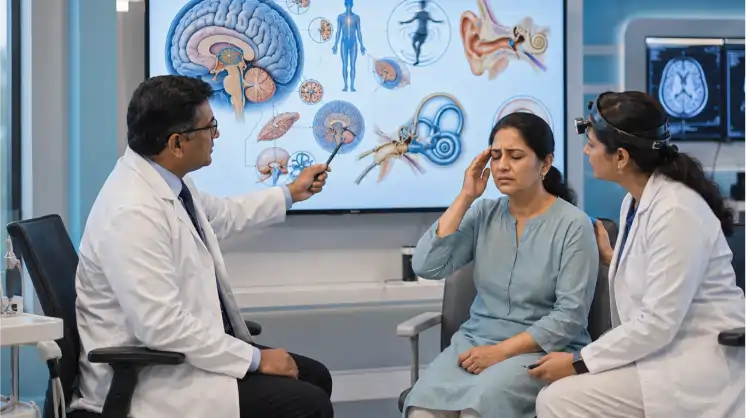
A patient with persistent dizziness may therefore need more than medication. A thorough evaluation may require specialists trained in vertigo and balance disorders, along with physiotherapists, occupational therapists, psychologists and professionals who can support mind-body rehabilitation.
This is why I believe multidisciplinary care is central to modern vertigo management.
Treatment should not simply aim to stop the sensation. It should address the underlying condition while helping the patient regain confidence in movement and everyday life.
The consequences of balance disorders can be profound. People may stop climbing stairs, travelling alone, driving, exercising or even turning their heads freely. For some, the fear of another episode becomes more disabling than the original symptom.
Good treatment therefore has a larger objective: to restore movement, independence and confidence.
This philosophy has shaped my work throughout my career and continues today at the Institute of Neurotology & Centre of Excellence for Vertigo & Balance Disorders at Pacific OneHealth, Delhi.
After four decades, I have learnt that every patient’s experience of dizziness is different. The lived experience of the patient must therefore remain at the centre of diagnosis and treatment.
We need to listen more carefully, investigate more precisely and bring the right expertise together.
Because successful vertigo care is not simply about making the room stop spinning.
It is about helping the person feel steady enough to live life fully again.
(The author is Dr Anirban Biswas, Principal Director – Institute of Neurotology & Centre of Excellence for Vertigo & Balance Disorders, Pacific OneHealth, New Delhi.)