Trying for a baby but nothing is happening? The problem may not be where you think
 37 Reads
 3 minutes read

Infertility is not just a woman’s problem. Here’s why both partners need to be part of the conversation.
By Dr (Maj.) Harshita Surange
“Doctor, we have been trying for months. Why is it still not happening?”
It is a question many couples ask quietly—and often, the woman is the first one sent for tests.
But here is something every couple trying for a baby should know:
Infertility is a couple’s issue, not just a woman’s issue.
Infertility is generally considered when pregnancy has not happened after 12 months of regular, unprotected sex. But you do not always have to wait a year to seek help. If periods are irregular, there are known reproductive problems, previous pelvic surgery, suspected endometriosis, increasing age or concerns about the man’s fertility, an earlier check-up may be sensible.
Could the problem be on the man’s side?
Yes. Infertility can be linked to the woman, the man, both partners—or sometimes no clear cause is found even after evaluation.
In a large WHO study, male factors were involved either alone or along with female factors in around 45% of couples studied.
So, if a couple is struggling to conceive, both partners deserve to be evaluated. The first step for a man is often a simple semen test. It looks at the number of sperm, how well they move and their shape.
And what about the woman?
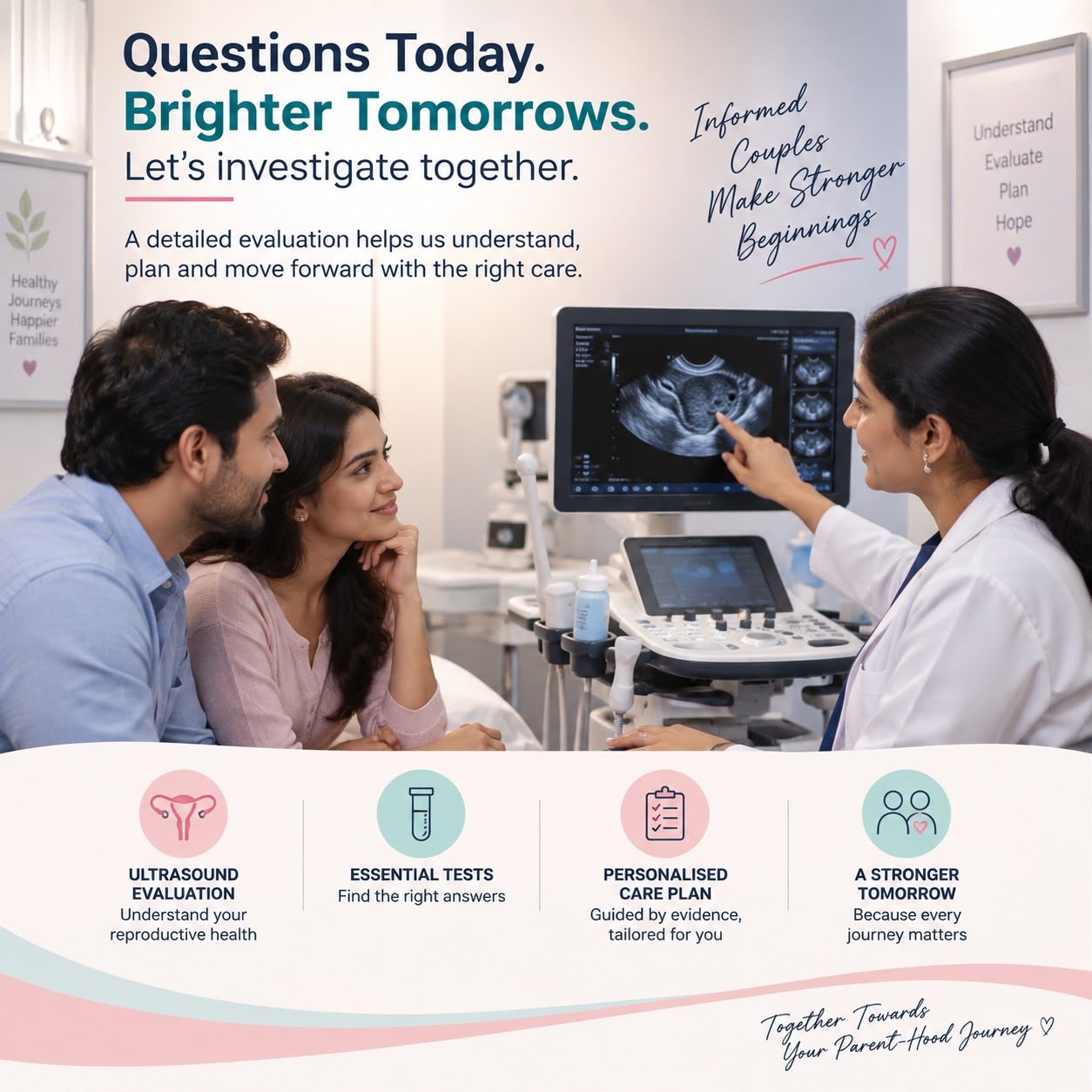
Depending on her age, history and symptoms, the doctor may recommend tests such as an ultrasound through the vagina to look at the uterus and ovaries, a test to check whether the fallopian tubes are open, scans to follow egg-containing follicles and ovulation, or selected blood tests.
You may not need all of these.
That is important. Good fertility care is not about doing every test available. It is about asking the right question first.
Is ovulation happening?
Are the tubes open?
Are the ovaries working as expected?
Does the uterus look healthy?
Are the sperm healthy enough?
But doctor, could stress be the reason?
Trying month after month can be emotionally draining. The pressure, uncertainty and fear of disappointment can affect sleep, lifestyle, relationships and overall wellbeing.But infertility should never simply be dismissed as:You are not conceiving because you are stressed.Physical causes need proper evaluation, while the emotional health of both partners also deserves care.
Why does the right diagnosis matter?
Because right diagnosis leads to right treatment. Treatment should not begin with a random list of tests or procedures.
Every test should have a purpose.
At Pacific OneHealth, the focus is to help couples understand what may be happening, investigate the possible causes systematically and move towards the next step with greater clarity and confidence.
Because when it comes to fertility, guessing can waste precious time.
Good treatment begins with good diagnosis.
(The author is the Principal Consultant, Radiology at Pacific OneHealth Hospital, Lajpat Nagar, New Delhi. She is a specialist in women imaging.)