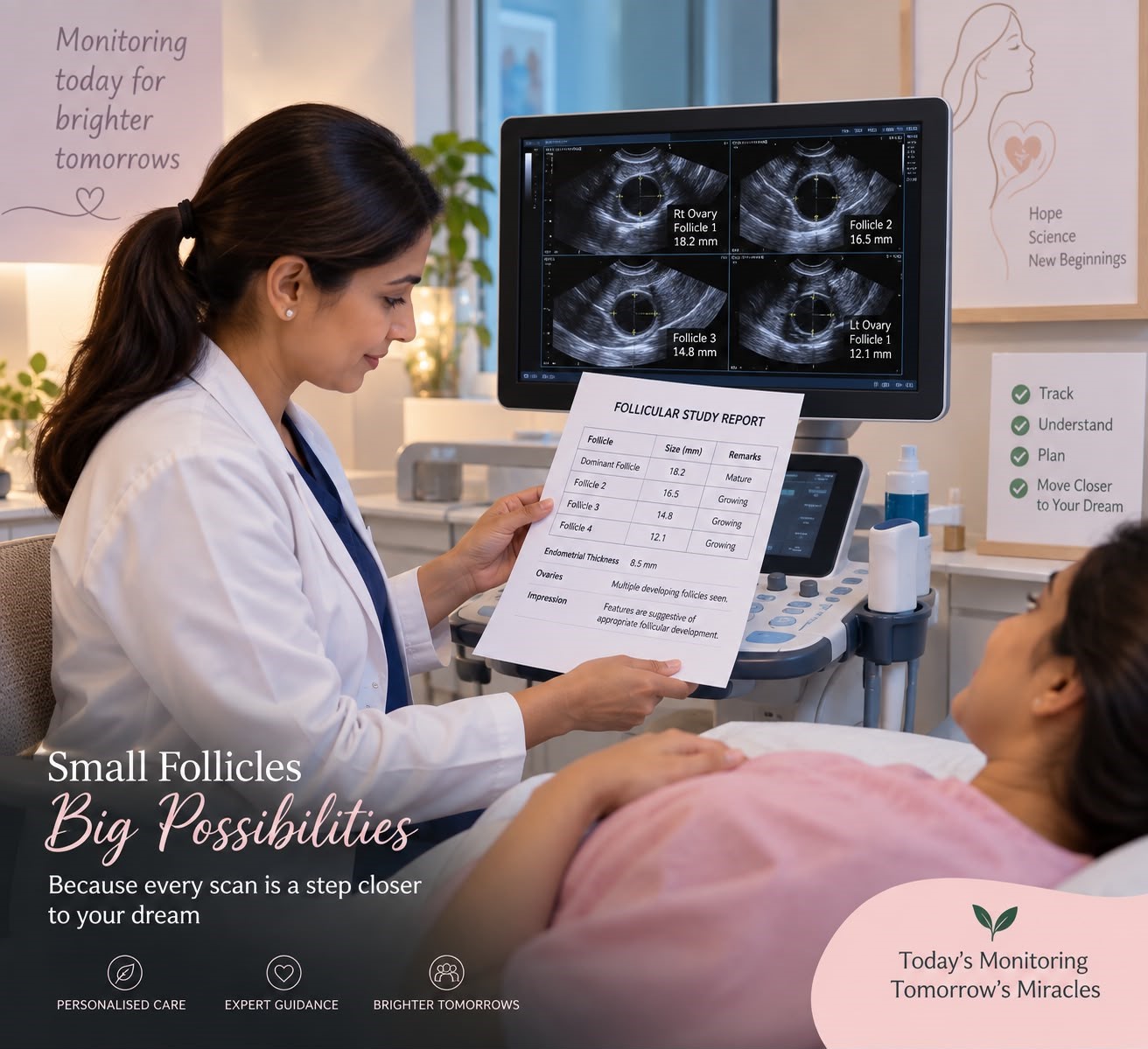
Trying for a baby? The scan that helps find the right time to try
 24 Reads
 3 minutes read

Follicular monitoring explained simply: when to start, how often you may need it, what the scan shows and why the first scan is only the beginning.
By Dr (Maj.) Harshita Surange
“Doctor, when should I come for the scan? And how will I know when I am actually ovulating?”
If you have been trying to conceive, you may have heard the words “follicular study” and immediately wondered: What exactly happens during it? Which day should I come? Will I need several scans? And does it mean I will get pregnant?
Let’s make it simple.
What is a follicular study?
A follicular study is a series of ultrasound scans performed during a menstrual cycle to watch how an egg-containing follicle develops and to identify when ovulation is likely to occur.
Unlike a single ultrasound, these scans allow us to follow what is happening over the course of the cycle. This information can help your doctor decide the appropriate timing for trying naturally or for fertility procedures such as IUI.
When should the first scan happen?
The first day of proper menstrual bleeding is Day 1 of your cycle.
A baseline scan is commonly done on Day 2 or Day 3, depending on your treatment plan. It gives us a starting picture of the ovaries and uterus.
After that, there is no universal Day 7, Day 9 or Day 11 rule. The timing of subsequent scans depends on how the follicles are developing and whether you are taking medicines to stimulate the ovaries.
In other words, your scan schedule is based on your cycle—not someone else’s.
What are we actually looking for?
With each scan, we follow the growth of the developing follicles and look for signs that one is becoming dominant and approaching ovulation.
We also assess the uterine lining, because conception involves more than just an egg.
As ovulation approaches, a follicle is often around 18–22 mm, although this can vary from woman to woman and from cycle to cycle. A later scan can also help identify whether ovulation has occurred.
Will the scan hurt?
Follicular monitoring is usually performed using a transvaginal ultrasound. A specially designed covered ultrasound probe is gently inserted into the vagina to obtain clear images of the ovaries and uterus.
There is no radiation involved. The examination is generally brief, although some women may experience mild pressure or discomfort.
Why do I need more than one scan?
Think of the first scan as the starting point.
The subsequent scans tell us the story—how the follicle is growing, how the uterine lining is developing and when ovulation may be occurring.
If you are undergoing fertility treatment, monitoring may become more frequent as the follicle approaches maturity.
Does a follicular study guarantee pregnancy?
No. It helps us understand ovulation and improve the timing of conception or fertility treatment, but pregnancy depends on several factors, including egg quality, sperm quality, fallopian tubes, the uterus and overall reproductive health.
One scan gives us a picture. A series of scans gives us the story.
At Pacific OneHealth, follicular monitoring is tailored to the individual cycle and treatment plan, helping your doctor make decisions based on what is actually happening—not simply on a calendar.
If you have been told to undergo a follicular study, don’t worry about remembering someone else’s scan schedule.
Ask your doctor when your cycle should be monitored—and let the scans guide the next step.
(The author is the Principal Consultant, Radiology at Pacific OneHealth Hospitals, New Delhi. She is a specialist in female imaging.)