Trying to get pregnant? This “simple ultrasound” can tell your doctor more than you think
 29 Reads
 3 minutes read

What a transvaginal ultrasound and antral follicle count can—and cannot—tell you about your fertility
By Dr (Maj.) Harshita Surange
“Doctor, I’m already having so many fertility tests. Why do I need an ultrasound too?”
It’s a completely fair question.
When you’re trying to conceive, every new test can feel like another source of anxiety—especially when you don’t know what it is looking for.
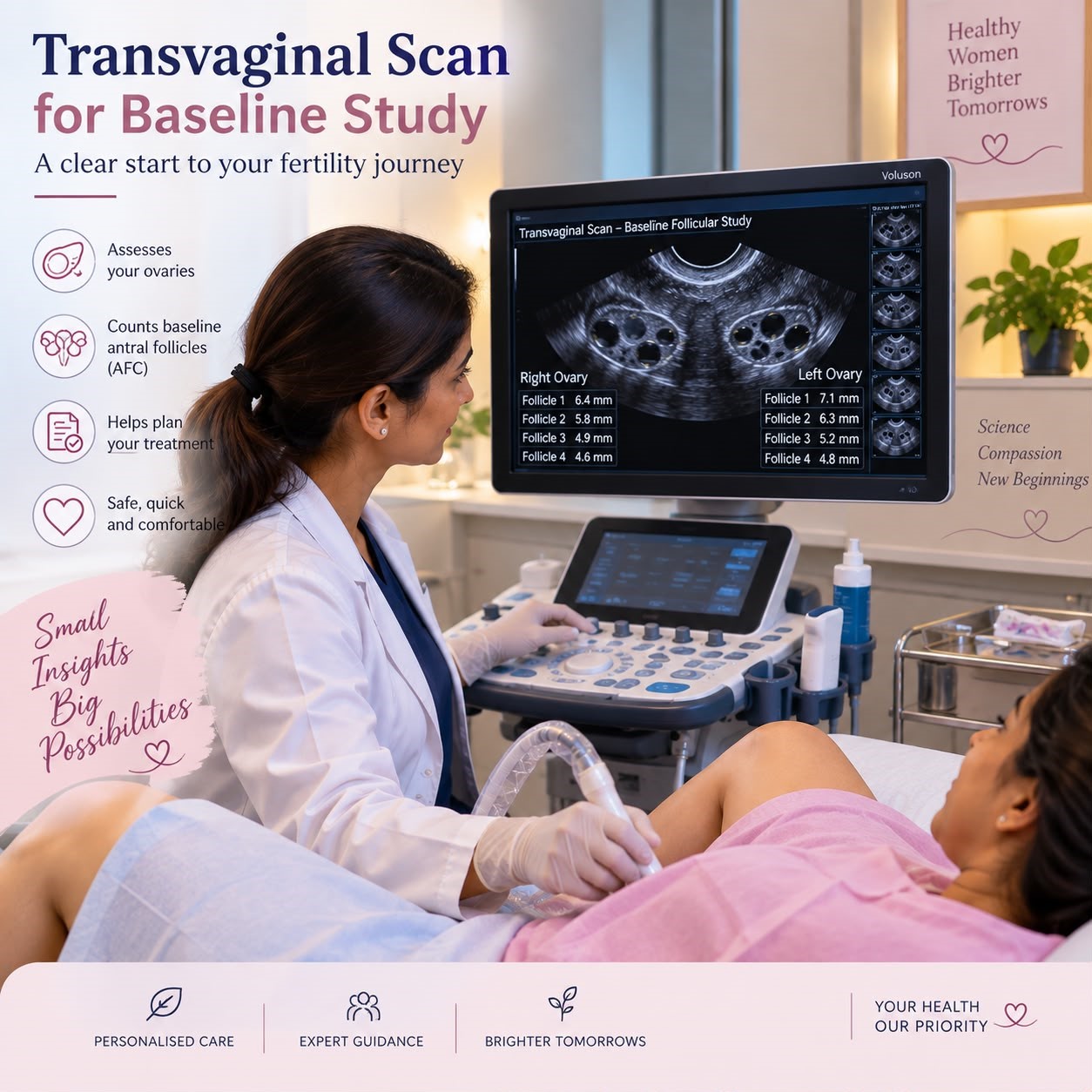
A transvaginal ultrasound, often called TVS, is much more than “just an ultrasound”. During a fertility evaluation, it gives us a close look at the uterus and ovaries and helps us understand what is happening inside the reproductive system.
One of the things we may look at is the antral follicle count, or AFC.
So, what exactly is an antral follicle?
Inside the ovaries are tiny fluid-filled sacs called follicles. These are where eggs develop.
Some of these small follicles can be seen on an ultrasound. We count the small follicles in both ovaries, usually early in the menstrual cycle. This number is called the antral follicle count.
It gives us an idea about the number of developing follicles visible at that point in time.
“When should I get the scan?”
AFC is generally assessed early in the cycle, commonly around Day 2 or Day 3, although it may be assessed during approximately Days 2–5.
Why so early?
Because the ovaries are relatively quiet at this stage, making the small follicles easier to identify and count consistently.
What if my AFC is low? Should I panic?
No. And this is important.
There is no single AFC number that defines fertility for every woman. The number can vary with age and other individual factors.
A lower AFC may suggest that the ovaries have a smaller remaining pool of follicles and may help doctors predict how the ovaries could respond to fertility medicines.
But a low AFC does not mean you cannot become pregnant.
AFC mainly gives information about the quantity of the follicle pool. It does not directly tell us the quality of the eggs, nor can it predict on its own whether you will conceive naturally.
Age remains an important factor when assessing reproductive potential.
So why is TVS useful during fertility treatment too?
This is where the ultrasound becomes particularly useful.
If you are undergoing fertility treatment, repeated scans can follow how the follicles are developing, assess the uterine lining and help your doctor decide when ovulation or a fertility procedure may be appropriately timed.
In simple terms, one scan gives us a picture; repeated scans can show us what is changing.
What else can the ultrasound reveal?
During a fertility evaluation, TVS can also help doctors look at:
- The shape and structure of the uterus
- The uterine lining
- Fibroids or polyps
- The ovaries
- Developing follicles
- The visible follicle pool
This information helps put the fertility picture together rather than relying on one test alone.
A final word from my desk
If you’ve been told you need a TVS or an AFC, don’t look at it as another test to fear.
Think of it as another piece of information that can help your doctor understand your reproductive health and plan the next step.
At Pacific OneHealth, the aim is to use each investigation to answer a specific clinical question—and, just as importantly, to explain the findings clearly.
An antral follicle count is a piece of the fertility puzzle. It is not a fertility verdict.
(The author is the Principal Consultant, Radiology at Pacific OneHealth Hospital, Lajpat Nagar, New Delhi. She is a specialist for women imaging.)