Why Do Joint Pains Increase During Monsoon? Orthopedic Experts Explain
 125 Reads
 4 minutes read

Introduction
Every year, as Delhi’s monsoon arrives, orthopaedic clinics see a predictable spike in appointments. Patients who managed their knee pain or back stiffness well through summer find that rain brings back aching joints, swollen knees, and morning stiffness. If you have ever wondered why your joints hurt more when it rains, you are not imagining it. Joint pain during monsoon is a recognised clinical phenomenon, and a consultation with the best orthopedic doctor can identify what is driving your symptoms.
Why Does Joint Pain Increase During Monsoon?
The most well-supported explanation is barometric pressure. As rain approaches, atmospheric pressure drops, allowing tissues around the joint tendons, muscles, and the synovial lining to expand slightly. In a healthy joint, this is imperceptible, but in a joint narrowed by cartilage loss or inflamed by arthritis, even small tissue expansion raises pressure inside the joint capsule, which the nervous system registers as pain.
Humidity and cold temperatures also affect muscle stiffness and fluid viscosity. Reduced activity during rainy days removes the natural lubrication movement provides, so joints stiffen faster. People with osteoarthritis, rheumatoid arthritis, old injuries, and gout are especially sensitive to these changes. The orthopedic hospital in Lajpat Nagar regularly sees patients across these categories each monsoon not because rain damages the joint, but because it amplifies an underlying condition that benefits from proper management.
Common Symptoms During Monsoon
- Aching or throbbing pain in the knees, hips, lower back, or shoulders
- Morning stiffness that takes longer to ease with activity than usual
- Swelling around the knees and ankles
- Reduced range of motion difficulty fully bending or straightening the joint
- Heaviness or fatigue in the affected limb
- Pain that worsens in the hours before or during rainfall
Diagnosis
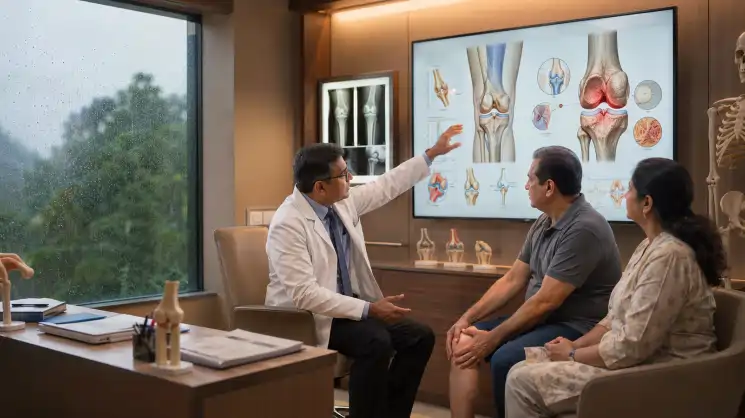
A knee pain specialist in Delhi, assessment starts with a clinical history of duration of pain, aggravating movements, and pattern, followed by examination of joint alignment, range of motion, and swelling. X-rays assess cartilage space and bony changes, MRI is used when soft tissue or early cartilage damage is suspected. Blood tests help distinguish inflammatory arthritis from mechanical or degenerative causes.
Treatment
- Physiotherapy – strengthens muscles around the joint and reduces the load on the cartilage; the most evidence-based long-term option for osteoarthritis
- Pain relief medication – NSAIDs and analgesics for acute flares, prescribed, not self-medicated.
- Intra-articular injections – corticosteroids for major flares; hyaluronic acid for joint lubrication in suitable candidates.
- Weight management – every kilogram lost reduces the load on the knee when walking by about 4 kilograms
- Heat therapy — Using heat before activity loosens stiffness and improves range of motion in monsoon
- Surgical Management – Joint replacement at orthopaedic hospital in Lajpat Nagar for severe osteoarthritis not responding to conservative treatment
Prevention in the Rainy Season
- You can still exercise indoors on rainy days with activities such as stationary cycling, yoga or pool walking to help lubricate your joints.
- Gentle range of motion exercises to loosen joints each morning before activity
- Dress warmly, and keep the affected joints covered. The cold makes your muscles stiffer.
- Maintain a healthy weight year-round to reduce baseline joint loading
- Stay well hydrated Adequate hydration is necessary to produce synovial fluid
When to visit a doctor?
Occasional discomfort that settles within a day or two is common and manageable at home. But see the best orthopedic doctor in Delhi if pain disrupts sleep or daily activities, if one joint is significantly more swollen, warm, or red than others, if there has been a recent injury to the affected joint, if pain is worsening progressively regardless of weather, or if fever, unexplained fatigue, or weight loss accompany joint pain. These are not weather-related patterns. They need a knee pain specialist assessment, not home management.
Conclusion
Joint pain in the monsoon is real, common, and manageable with the right combination of physiotherapy, medication, lifestyle adjustment, and specialist input. The best orthopaedic doctor at our orthopaedic hospital in Delhi, Lajpat Nagar, provides the diagnosis and plan that moves you from pain management to genuine recovery.