You have time for everyone except yourself. Your body is keeping score
 48 Reads
 4 minutes read

By Padma Shri Prof. Dr Mohsin Wali
Somewhere between getting the children ready, answering the work messages you promised yourself you would ignore, checking on your parents and finally collapsing into bed, you stopped checking on yourself.
Not because you don’t care. You simply keep telling yourself:
“I’ll deal with it later.”
The workout can wait until next Monday. The health check-up can wait until work settles down. The extra weight? You’ll lose it after the next project. That tiredness? Probably just stress. And that is how “later” quietly becomes a lifestyle.
Your 30s may be asking a question you don’t want to answer
A new Delhi-NCR health screening study has thrown up a number that should make Millennials pause.
Among people aged 30 to 44, 55.7% were found to be overweight or obese. Is this not end signal to alarm on time, unless late.
The findings come from Pacific OneHealth’s OneHealth Total Metabolic Wellness Study 2026, which screened 4,000 people across Delhi-NCR across multiple metabolic health parameters. The study found that metabolic risks were appearing much earlier than many people expect.
And that is what makes this uncomfortable. You may still feel young. You may still be working long hours, raising a family, travelling, making plans and thinking about the future.
But your body may already be accumulating risks that don’t necessarily announce themselves with pain.
That’s the trap.
You don’t have to feel ill to be metabolically unhealthy
High blood pressure doesn’t always give you a warning. Excess visceral fat — the fat stored deep around internal organs — may not be obvious when you look in the mirror. And a normal-looking body does not necessarily mean everything underneath is healthy.
In fact, the Pacific OneHealth study found 176 people with a normal BMI who nevertheless had elevated visceral fat, highlighting why weight alone may not tell the whole story.
This is why “I look fine” isn’t necessarily the same as “I’m fine.”
The problem isn’t that Millennials don’t care about health
It’s that health is competing with everything else. The school fees. The EMI. The 9 pm meeting. The ageing parents. The child’s homework.
The weekend that disappears before you’ve had a chance to rest. And somewhere in between all of that, your own health keeps getting pushed to the bottom of the list.
In my practice, I often see the consequences of this delay.
The worrying part is not that people don’t want to be healthy. They do.
The problem is that many waits for their body to produce a dramatic symptom before they take action. By then, years of small changes may already have accumulated.
So, what should you actually do?
Not quit your job.
Not spend two hours in the gym every day.
Not follow the latest diet trending on Instagram.
Start smaller.
Sleep well.
Quit alcohol.
Know your numbers.
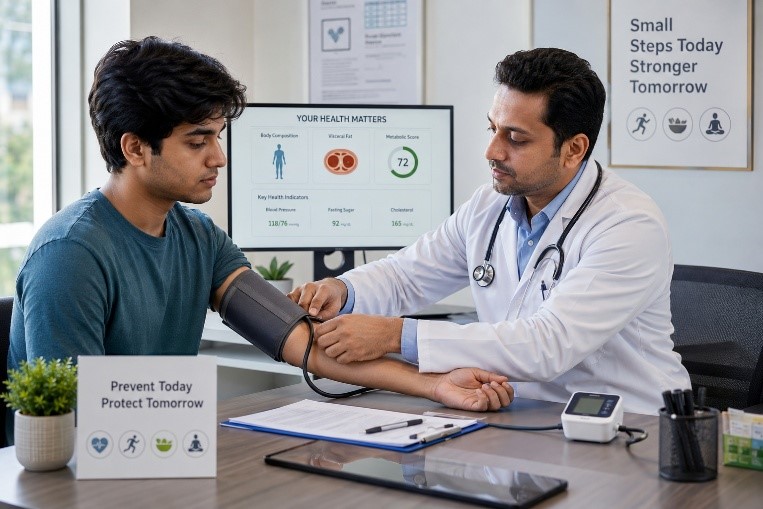
Get your blood pressure checked regularly. Look at your weight and waist circumference. Discuss your blood sugar and cholesterol with your doctor when appropriate. And where indicated, consider a more comprehensive metabolic assessment rather than relying on BMI alone. We are heading another epidemic of normal BMI, normal weight obesity called sarcopenic obesity.
The OneHealth study’s findings reinforce the importance of looking beyond a single measurement and identifying metabolic risks earlier.
Your health doesn’t need another promise. It needs 15 minutes.
You don’t need to become a different person overnight. You need to stop postponing the conversation with your own body. Because your 30s aren’t the age when you should be waiting for disease to arrive before you start thinking about prevention.
This is the decade when you can still change the direction of the story.
So, before you answer the next email, attend the next meeting or solve someone else’s problem, ask yourself one question:
“When was the last time I checked whether I was actually okay?”
If you can’t remember, perhaps that’s your sign. Give yourself the fifteen minutes.
Because Your family needs you. Your work needs you. But you need you, too Heal Thyself.
(The author is a Padma awardee and a Senior Consultant – Internal Medicine & Preventive Care, Pacific OneHealth, New Delhi)